Welcome back to The Studying Speechy!
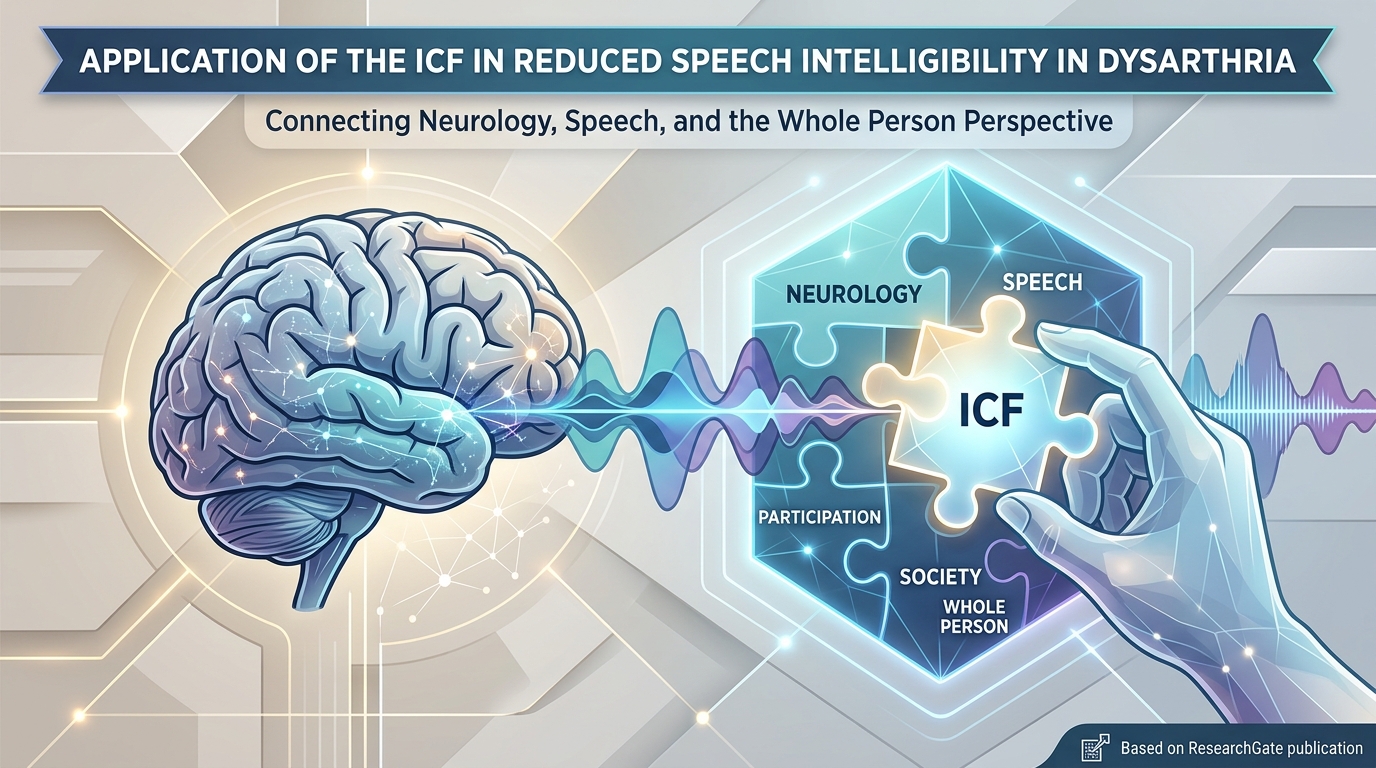
Today, we are taking a deep dive into an insightful journal article by Dykstra, Hakel, and Adams (2007) titled “Application of the ICF in Reduced Speech Intelligibility in Dysarthria”.
If you’ve ever worked with a client with a motor speech disorder, you know that calculating their intelligibility percentage is standard practice. However, this article argues that to truly help our clients, we have to look beyond traditional severity scores. By applying the World Health Organization’s International Classification of Functioning, Disability and Health (ICF) framework, we can better understand the complex, multidimensional reality of living with dysarthria.
Let’s break down the research into bite-sized, easy-to-understand pieces!

What is Dysarthria?
Before we get into the framework, let’s establish our definitions.
- Dysarthria is a motor speech disorder caused by central or peripheral nervous system damage.
- This neurological damage results in problems with muscular control, leading to paralysis, weakness, or incoordination of the speech muscles.
- It is highly common in conditions like Parkinson’s disease, amyotrophic lateral sclerosis (ALS), and Friedreich’s ataxia.
- Almost universally, a primary consequence of dysarthria is a reduction in speech intelligibility, which is simply defined as how well a listener can understand the speaker’s acoustic signal.
Breaking Down the ICF Framework for Speech Intelligibility
Traditionally, SLPs measure intelligibility in a quiet room to assign a severity score. While helpful, this decontextualized number doesn’t tell us how the client actually functions in the real world. Here is how the ICF framework categorizes the experience of dysarthria:

The Speechy Takeaway
As future and current SLPs, we must remember that treating dysarthria is about more than just boosting a percentage score on an intelligibility test. By using the ICF framework, we can identify environmental barriers, leverage our clients’ personal strengths, and design interventions (like Bill’s amplifier) that truly improve their ability to participate in the activities they love.
Reference:
Dykstra, A. D., Hakel, M. E., & Adams, S. G. (2007). Application of the ICF in reduced speech intelligibility in dysarthria. Seminars in Speech and Language, 28(4), 301–311. https://doi.org/10.1055/s-2007-986527
[cite: 2, 3]
What are your thoughts on using the ICF framework in the clinic? Let me know in the comments below!
Leave a Reply